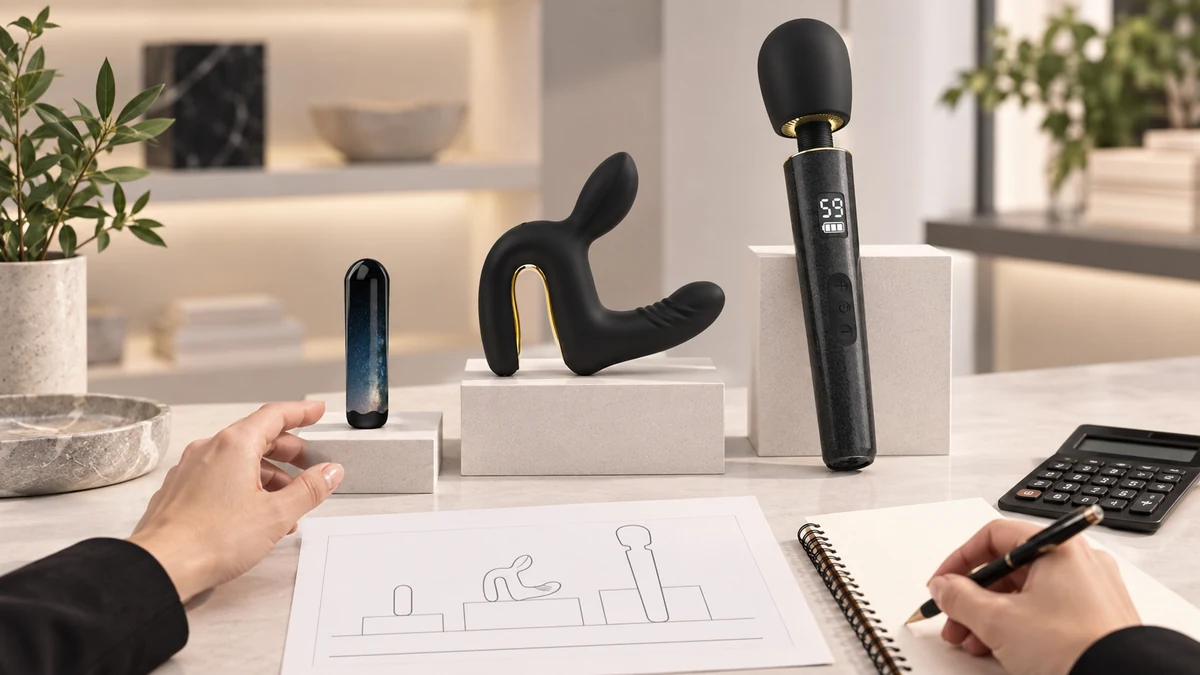

A new retailer selects twelve products from a supplier catalogue. Eight are similar small vibrators. Three are different colors of the same shape. The final product costs more, but the store cannot explain the difference beyond the words "better quality."
The store has twelve product codes but only two real customer choices. Customers still do not know which product fits them, and the retailer cannot learn what buyers actually prefer from the sales results.
The purpose of an opening assortment is not to display as many SKUs as possible. It is to use a focused number of products to cover the core functions that matter to the target customer, while giving customers clear and useful choices within each priority function.
As an AIYUEWEI planning reference, many new retailers can begin with about 18 to 30 active SKUs. A tightly focused single channel pilot may begin with 12 to 18. Consider 30 to 40 only when the team, budget, product data and promotion capacity can support the range, and when every additional product fills a real function gap.
These figures are planning references. They are not a universal adult toy industry average, and they are not a required purchasing quantity. The final range should follow the retailer’s target market, sales channel, main customer missions, budget, supply conditions and content capability.
Fixture capacity is a reference, not a buying target
Public retail fixture information says that a conventional four foot wide and 72 inch high gondola section may hold about 50 to 100 SKUs depending on product size. Real four foot by eight foot planograms show 17, 27, 32, 42, 46 or 59 SKUs, which demonstrates how product size, packaging and display method can change physical capacity. Public planogram reference
This article uses those figures only as physical capacity references. They do not mean that a new store should purchase that many products, and they should not be converted into a fixed number of SKUs per square meter.
A fixture that can hold fifty products does not require fifty products on opening day. A focused range of twenty four products with clear functions may be easier for customers to understand. It also leaves room for extra facings, comparison cards, testers and products that later earn more visibility.
Unused display space is not automatically wasted space. It can support proven core products, functions that customers repeatedly request and future additions that have a clear commercial reason.
Build a function coverage map before setting the SKU count
Covering all functions should not mean purchasing every feature available in the market. A more useful definition is to cover the core needs of the target customer, so the store does not leave an important customer mission without a suitable option.
A new retailer can organize the function map through four dimensions:
- Stimulation method, such as vibration, air or pulse sensation, stroking, dual stimulation, and other methods that matter to the target audience.
- Use occasion, such as individual use, couples, male products, quiet or travel use, gifting, and other real customer situations.
- Control method, such as button control, remote control, app control, and other verified control methods.
- Experience level, including an easy first purchase, a visible step up, a multifunction option and a higher priced advanced choice.
Not every store needs every example above. The retailer should use its target customer and channel evidence to decide which functions are core, which deserve additional choice and which should remain controlled tests.
Give every core function at least two meaningfully different choices
With only one option, the customer cannot compare. With too many similar options, the customer may not know where to begin.
A practical approach is:
- Keep two products for each core function at the start.
- Make the first product easy to understand with a lower purchasing barrier.
- Make the second product a visible or explainable upgrade, such as a different control method, a clearly different stimulation method, a different size, a different use occasion or a verified combination of functions.
- Add a third option only for a priority function supported by store sales, site search, customer questions or other channel evidence.
- For an unproven function trend, use one controlled test product rather than several similar products.
A color change is not a new function choice. If two products solve the same need, use the same control method and require the same explanation, they should not occupy two opening positions unless the retailer has evidence that the color itself changes purchasing behavior.
Multifunction products can reduce SKU count without creating false coverage
A multifunction product can cover two or more real customer missions. For example, one product may combine different stimulation methods, or support both a couples occasion and remote control. This can help a limited buying budget cover more use situations without repeating similar SKUs.
Only verified functions should count toward the coverage map. A package with several marketing phrases does not automatically make one product five different solutions. The retailer should still confirm:
- Whether each function can be used and explained clearly
- Whether customers can understand the difference through images, specifications or a demonstration
- Whether the combined functions solve a real customer problem
- Whether product dimensions, control guidance, charging information and authorized images are complete
A multifunction product may fill several cells in the function map, but it remains one SKU in the purchase count.
A worked opening range with twenty four SKUs
The following is a planning example, not a fixed category list:
- Select six verified core function groups and provide two clearly different choices in each group, for twelve SKUs.
- Add four multifunction products that cover related customer missions, for four SKUs.
- Add four occasion based products, such as couples, quiet or travel use, gifting or male products. The actual occasions should follow the target customer.
- Add two advanced or higher priced choices with a visible difference.
- Add two controlled test products, each answering one new function, format or price question.
The total is twenty four SKUs. This creates more useful learning than placing twenty four similar vibrators on one fixture because every position has a different commercial job.
For every candidate, complete the sentence, "This SKU is in the opening order because it covers ______, and the current products do not solve that need in the same way."
Remove duplicate candidates when several products produce almost the same answer.
Check whether the assortment makes customer choice harder
After building the opening range, do not ask only what other products could be added. Ask whether the customer can understand the differences quickly.
Use three simple checks:
- Does one core function contain more than three highly similar products? If so, reduce the group.
- Can a salesperson or product page explain the difference between neighboring choices in one sentence? If not, improve the content or select different products.
- Can the customer narrow the range first by function, then by price or use occasion? If the customer sees only a row of similar shapes, the assortment is still unclear.
A useful assortment does not show the greatest possible number of products. It helps the customer reduce the choice step by step.
SKU count also multiplies the real buying commitment
The number of active SKUs and the units purchased per SKU are separate decisions, but they use the same cash and storage capacity.
Suppose one purchasing condition requires twenty units per selected SKU. This is an arithmetic example, not a statement of AIYUEWEI’s current MOQ:
- Twenty SKUs require 400 units
- Thirty SKUs require 600 units
- Forty SKUs require 800 units
If forty SKUs exceed the budget, do not remove entire core functions first. Preserve function coverage and remove repeated shapes, repeated colors and upgrades that cannot be explained. Keep second stage products in the candidate list rather than placing them in the opening order.
For every candidate SKU, include product cost, packaging cost where applicable, estimated freight share, import cost, payment timing and the quantity needed for display, sales and replacements. Unknown costs should remain unknown until confirmed.
Package dimensions decide display method, not the required SKU count
Catalogue images are not scale references. A compact vibrator and a large stroker may look similar in separate product images while requiring very different shelf width, depth and back stock space.
Before confirming the opening assortment, collect:
- Product and packaged width, height and depth
- Hanging or shelf display method
- Units per carton and carton dimensions
- Space required for a tester or display sample where applicable
- Planned number of facings for the SKU
Use these details to plan the fixture, image scale and stock space. Do not let the available fixture force the retailer to fill every position.
Our sex toy product data for ecommerce listings guide covers the verified information needed before a listing goes live.
When should a retailer add more SKUs?
The opening range is a buying hypothesis, not proof of market demand. Give the current products fair exposure before expanding.
Add a new SKU only when there is a clear reason, such as:
- Customers repeatedly ask for a function or occasion that the current range does not cover
- A core function sells consistently and needs a clearer entry, upgrade or multifunction choice
- A product becomes a stable core item and needs a complementary product at another price or use occasion
- The store has the images, specifications, content and promotion capacity needed for the new product
- Inventory and replenishment can support the expansion without removing exposure from the current range
Do not add SKUs only because the fixture has empty space or because a supplier catalogue contains new products.
Our sex toy product variant and SKU planning guide explains why unnecessary colors divide a small data set. Once the retailer has sales history, use a separate Test, Core and Hero process to decide which SKUs deserve expansion.
How AIYUEWEI can help plan the opening assortment
AIYUEWEI can build a function coverage map from the retailer’s target market, sales channel, main customer missions, budget and content capability. We can then organize candidate products as basic choices, visible upgrades, multifunction products, occasion based products and controlled tests.
We can identify function gaps and remove repeated SKUs that change only color or shape without adding customer value. For shortlisted products, we can coordinate with relevant partner factories and supply resources to verify specifications, authorized images, package information, carton data and current purchasing conditions.
We do not present an unverified popular function or bestseller label as a sales guarantee. Priority functions still need to be judged through the target market, channel data, customer questions and real sales results.
Frequently asked questions
How many SKUs should a new sex toy retailer start with?
As a planning reference, many new retailers can begin with 18 to 30 active SKUs. A tightly focused single channel pilot can begin with 12 to 18. Consider 30 to 40 only when each additional product fills a clear function gap and the budget, data and promotion capability can support it.
Must the opening range cover every function in the market?
No. It should cover the core functions and use occasions that matter to the target customer. An unproven function can begin as one controlled test product.
How many choices should each priority function receive?
Start with two meaningfully different choices. One should be easy to understand, and the other should provide a clear step up. A priority function with demand evidence may receive a third choice. A multifunction product can cover more than one function gap, but it remains one SKU.
Will an unfilled fixture look incomplete?
Not necessarily. Use extra facings for priority products, comparison information, testers, signs and intentional breathing room. A fixture that is easy to understand can be more useful than a full fixture of products with small differences.
Build an opening range that customers can understand
Share the target market, sales channel, main customer, required functions, buying budget, planned retail prices and known purchasing conditions through our enquiry page. AIYUEWEI can help turn those inputs into a focused candidate assortment and a list of product and package data that still needs verification.