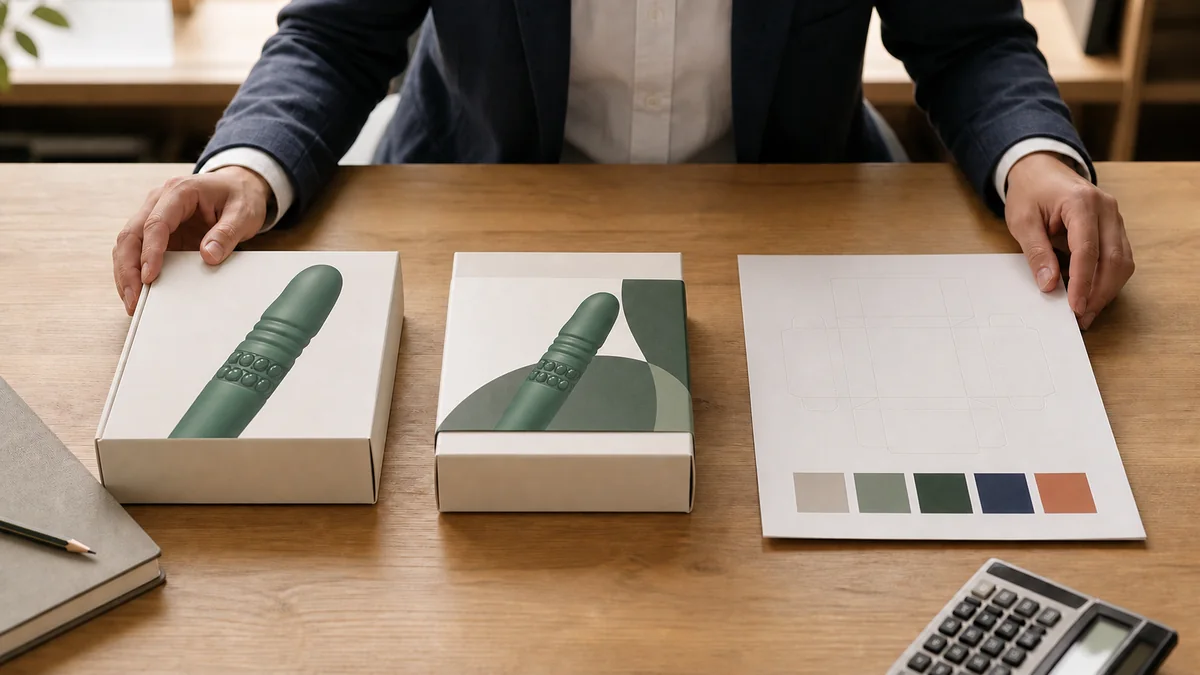
Many first time brand owners start a sex toy launch by discussing logos, colors and packaging. That sequence feels productive, but it can hide the most important question: what does the first order need to prove?
If the product itself has not been tested, the buyer is taking two risks at the same time. The product may not sell, and the investment in branding may not be recovered. A better route is to choose the level of customization that matches the question the launch must answer.
First decide what the launch must prove
A first order can have three very different jobs.
- Product demand: Which category, function, shape or price range attracts real orders?
- Brand presentation: Will a stronger brand identity and better packaging improve conversion or support a higher price?
- Product differentiation: Is there a proven feature, structure or specification gap that existing products do not solve?
These jobs lead to three different launch routes: ready stock, light private label and deeper customization.
Route 1: Use ready stock to learn what will sell
Ready stock reduces the number of unknowns in the first decision. A buyer can test the category, feature set, price range and product page without also taking on packaging development, special color minimums and approval delays.
This route is useful when:
- You are entering a sex toy category for the first time.
- You do not yet know whether customers care most about function, shape, material or price.
- You want a controlled group of SKUs so you can compare clicks, add to cart activity, purchases and returns.
- You need to launch quickly and learn from real customer behavior.
Ready stock is not automatically the best long term strategy. Available colors and packaging may be limited, and the product may have less visible differentiation. Its main value is to provide a lower complexity test before the brand commits more money.
Route 2: Use light private label to test brand presentation
When the product direction is clearer but the value of the brand presentation is still unknown, light private label can be the next step. Depending on the product and supply conditions, this can include a logo, an available color, a branded sticker, an instruction card, a packaging sleeve or a custom box around a mature product platform.
The important detail is that one project can contain several minimum order quantities. The product, a specified color, logo application, printed packaging, accessories and shipping cartons may each have a different minimum. Buyers should not ask only, “What is the MOQ for customization?” They should ask which part creates each minimum.
Why packaging quantity may not match product quantity
Packaging suppliers often have their own printing minimums. A larger printing run can reduce the unit cost because setup and production costs are spread across more boxes. It may also improve scheduling reliability. A very small packaging order can be placed later in the supplier’s production queue, which can delay the full product delivery even when the products are ready.
Extra packaging can sometimes be stored for the next reorder. This can shorten the next packaging step and protect the project from another small printing run. However, the buyer should confirm the storage responsibility, quantity record, moisture and pressure protection, and whether the design will still fit the next production batch.
Ordering too much packaging creates another risk. Cash is tied up, and old boxes may become unusable after a product dimension, legal text, barcode or brand design changes. A practical decision is to reserve packaging only after there is a reasonable expectation of a reorder, and to avoid printing changeable details permanently when a label or insert can handle them more safely.
Route 3: Choose deeper customization only when the gap is clear
Deeper customization should solve a known customer or channel problem. Examples can include an unsuitable control layout, a repeated usability complaint, a missing function combination, or a specification that the current product platform cannot provide.
“We want something unique” is not enough by itself. A project can become more expensive and slower without creating clearer value for the buyer’s customers.
Before considering a new structure or tool, look for three types of evidence:
- A reasonably stable target customer and price range.
- Sales, reviews, support records or channel feedback that point to the same gap.
- Expected demand that can support development, samples, approvals, minimum production and future reorders.
Use three decision gates
Gate 1: Do you need to learn which product will sell?
If yes, start with a controlled ready stock test. Keep the assortment focused enough that the result can be understood.
Gate 2: Does the product already sell, but the brand presentation is unproven?
If yes, test light private label on a mature product platform. Compare the result with the earlier presentation and record whether conversion, price acceptance or repeat purchase actually changes.
Gate 3: Do repeated customer signals identify one product gap?
If yes, evaluate deeper customization against a written product requirement. The requirement should explain the problem, target user, expected improvement and commercial volume.
This sequence keeps each order aligned with one learning goal. A first launch does not need to be the final product, but it should produce information that improves the next decision.
Compare the cost of a useful test, not only the unit price
The real launch budget may include samples, packaging design, printing setup, unused printed boxes, inspection, freight, receiving, unsold inventory and the opportunity cost of a delayed launch.
A lower unit price may require a higher quantity. If the buyer commits more cash to unproven SKUs, the cheaper unit can create a more expensive test. The better route is the one that answers the current business question with acceptable risk.
For more detail on why product, color and packaging minimums can differ, see our guide to private label sex toy MOQ layers. If you need a clearer definition of cooperation models, compare OEM, ODM and private label adult products. A structured sex toy RFQ also helps separate product requirements from assumptions.
How AIYUEWEI Can Help
AIYUEWEI can organize ready stock, light private label and deeper customization options for the same group of candidate products. The comparison can include only conditions confirmed for the specific project, such as product MOQ, color or logo requirements, packaging minimums, available packaging routes, sample and approval steps, and the components of the expected lead time.
This gives the buyer three executable launch paths instead of three vague labels. Stock, MOQ and lead time must still be confirmed for each SKU and project. We do not replace a current project check with generic numbers.
Frequently Asked Questions
Does a new brand need private label packaging from the first order?
Not always. If the product direction is not yet proven, ready stock can reveal whether the category and price range deserve further investment. Branding can be tested after product demand is clearer.
Can printed packaging be stored for the next order?
It can be possible when the material, product size, legal text and storage conditions remain suitable. Confirm who stores it, how the quantity is recorded, how it is protected, and what happens if the product changes.
When is a new structure or tool worth considering?
Consider it when stable sales and repeated customer evidence identify a gap that an existing platform cannot solve. Being different is not a sufficient commercial reason by itself.
Plan the next step
If you are comparing launch routes for a first product line, prepare the target market, sales channel, category, budget range, expected quantity and the question the order must answer. Send AIYUEWEI the project details, and we can separate the available routes and identify which conditions need a current quotation.